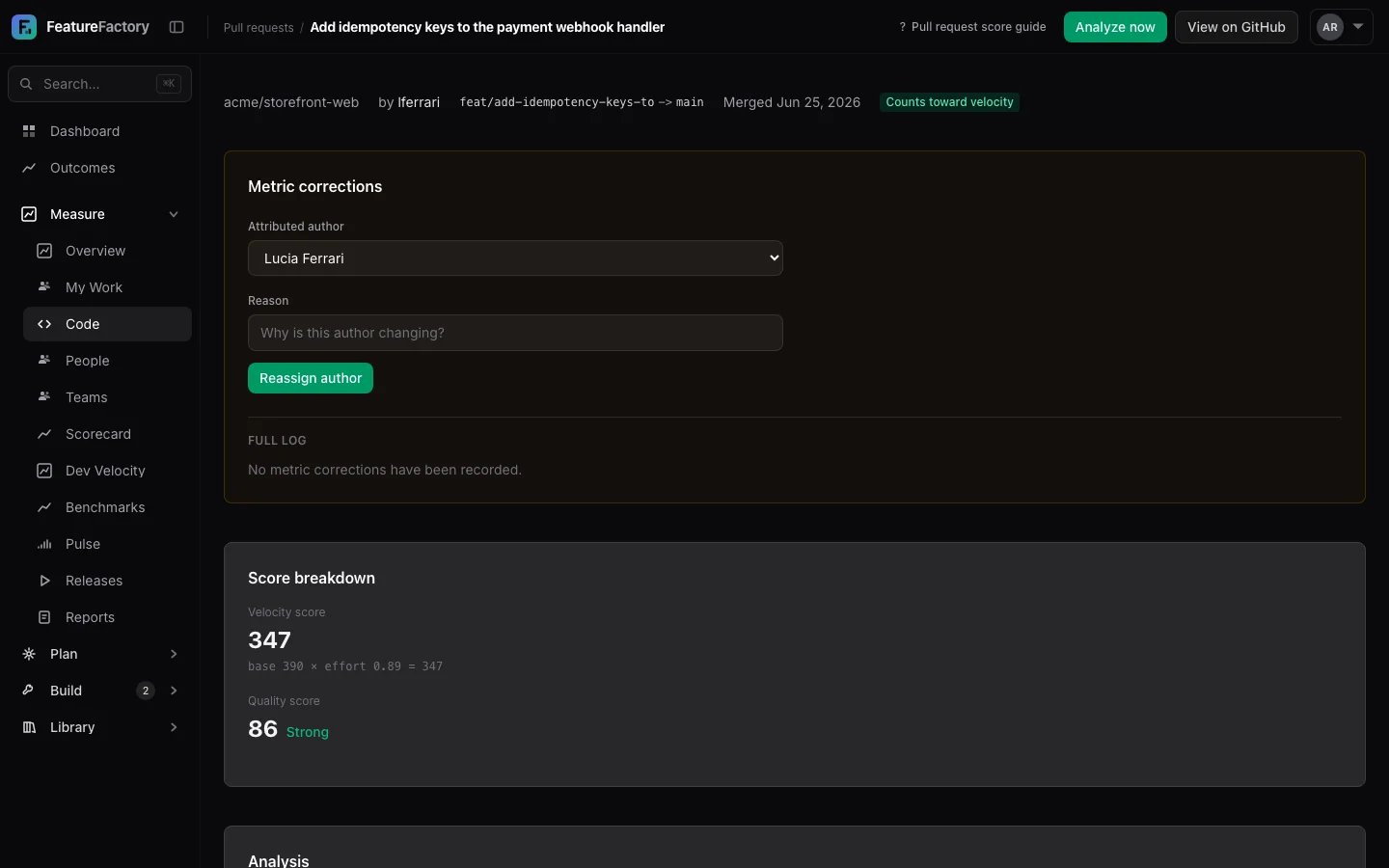
PR quality with a rationale
Score each merged change against a visible rubric for correctness signals, tests, scope, and maintainability.
You get: A 0-100 score you can open, read, and challenge.
Pillar 01 · Measure
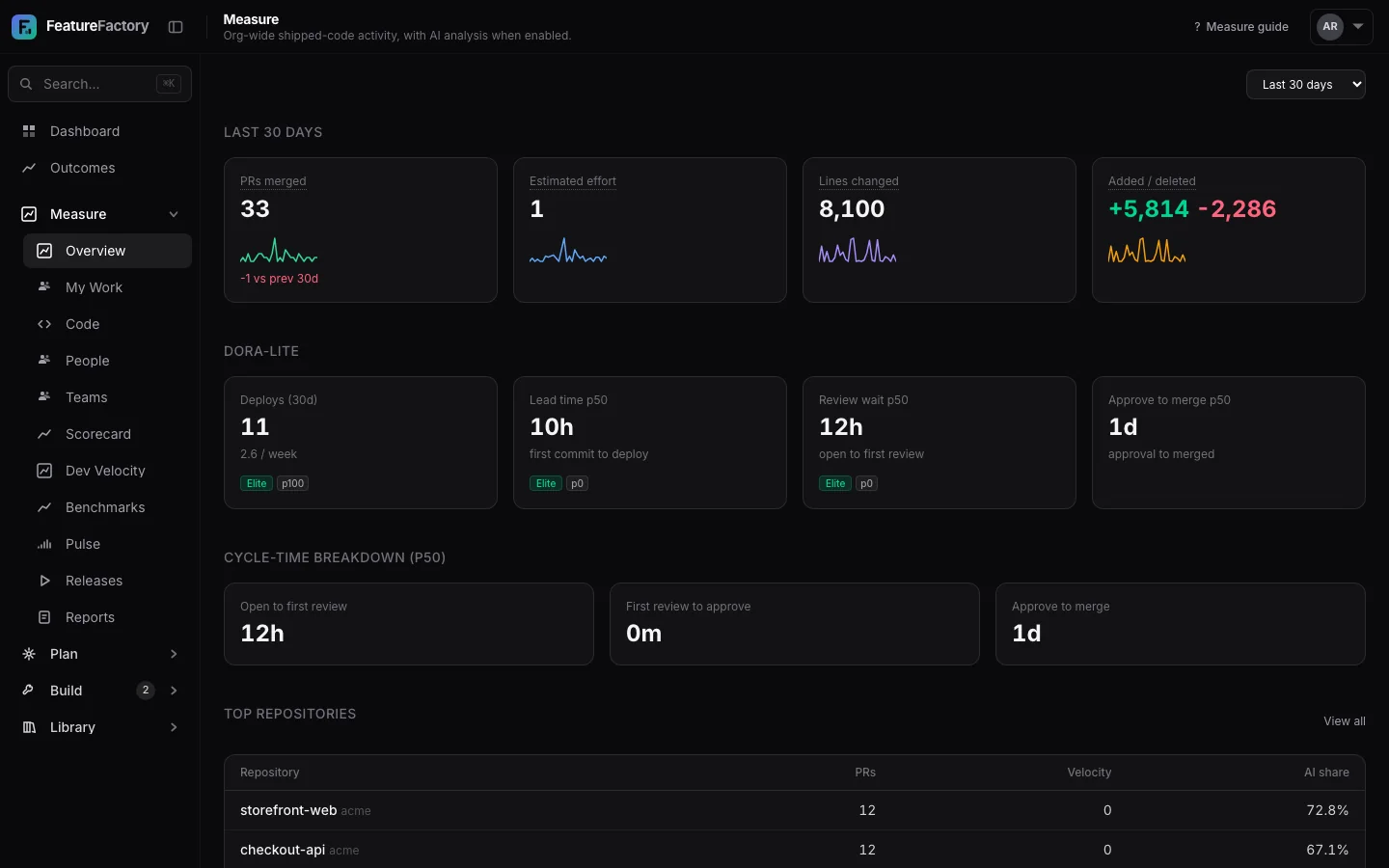
Measure the quality, speed, authorship, and durability of every shipped change-then trace each number back to the work behind it.
AI-assisted vs human
Quality and flow comparison
What Measure gives you
Score each merged change against a visible rubric for correctness signals, tests, scope, and maintainability.
You get: A 0-100 score you can open, read, and challenge.
Separate known AI-authored, AI-assisted, and human work using explicit repository and identity signals.
You get: An authorship view that distinguishes evidence from estimates.
Track lead time, coding time, pickup, review, and merge without reducing engineering work to one speed number.
You get: The stage creating delay-not just the total duration.
Follow churn, reverts, fixes, and related regressions after a change lands instead of declaring victory at merge.
You get: A durability signal that exposes false velocity.
Compare people, teams, repositories, work types, and authorship while keeping the underlying changes accessible.
You get: Individual profiles and ranked leaderboards backed by delivery evidence.
Read quality, flow, authorship, and outcomes together for a release, initiative, team, or period.
You get: One view for deciding where to invest or intervene.
Inside FeatureFactory
These views use representative product data. Open any image at full size to inspect the workflow and supporting context.
Example · evaluate an agent rollout
A team introduces an AI coding agent on a checkout service. Measure compares like-for-like shipped work before anyone declares success.
Illustrative workflow · sample data, not customer results
Baseline
01Choose the repo, work type, period, and existing quality and flow measures.
Sample: checkout service · feature work · previous 30 days
Attribute
02Use explicit authorship signals and show unknown or estimated work instead of forcing certainty.
Sample: 18 AI-assisted · 7 human · 3 unknown PRs
Decide
03Compare cycle time, review effort, quality rationale, and post-merge rework on the same cohort.
Sample decision: expand on scoped UI work; raise review on payment logic
Decisions, not vanity metrics
Each view is designed to resolve a real product or engineering question-and keep the evidence close enough to challenge.
Find work types where AI-assisted changes move faster without lowering review depth or durability.
Trace low-scoring or high-rework changes back to the diff, rationale, repository, and workflow.
Adjust agent scope, review policy, specification quality, or team process based on the actual constraint.
Proof you can inspect
See what the PR quality score evaluates and how the written rationale supports it.
Read scoring methodologySee the signals, confidence levels, and limits behind AI contribution reporting.
Read attribution honestyUse the free estimator to see which review signals affect a PR quality assessment.
Try the PR quality estimatorSee how ranked performance combines velocity, quality, review contribution, rework, and AI context.
Explore developer performance trackingBefore you connect
See it on your own work
Join early access to establish your quality, flow, and AI-attribution baseline from your own delivery history.