Scoped work orders
Translate an approved product plan into bounded work with repo context, dependencies, acceptance criteria, and a definition of done.
You get: A unit of work an agent can execute without guessing the product intent.
Pillar 03 · Build
Turn approved plans into scoped work orders, execute with agents you control, keep engineers at the judgment gates, and measure the result after merge.
Controlled execution
Spec → agent → PR → measured
What Build gives you
Translate an approved product plan into bounded work with repo context, dependencies, acceptance criteria, and a definition of done.
You get: A unit of work an agent can execute without guessing the product intent.
Route work to the coding agents your team already trusts instead of moving engineering into a closed service workflow.
You get: A consistent contract across Claude Code, Cursor, and future agents.
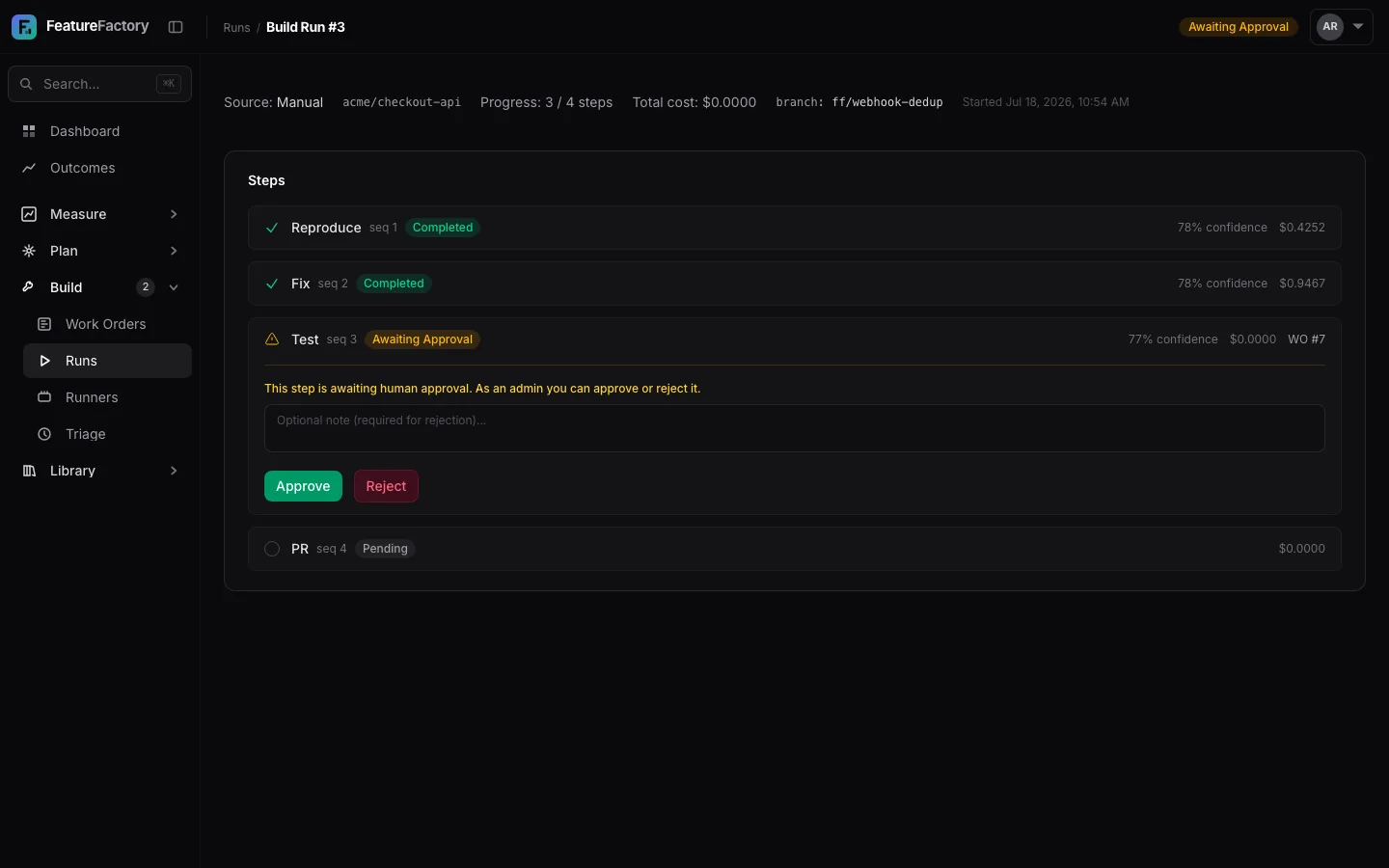
Keep approval, repository policy, tests, and code review as controlled gates around agent execution.
You get: Acceleration without removing engineering judgment.
Carry the original problem, requirements, and acceptance criteria through to the pull request and review.
You get: A reviewer can see why the change exists-not just what changed.
Link shipped work back to the themes, accounts, and outcomes it was intended to affect.
You get: A release record that supports follow-up instead of ending at deploy.
Feed the shipped change into quality, flow, rework, and outcome measurement automatically.
You get: A closed loop that reveals whether the build was actually successful.
Example · execute the checkout recovery product plan
The approved checkout-recovery plan becomes a scoped work order. The agent receives the right context, the engineer keeps the review gate, and the result returns to measurement.
Illustrative workflow · sample data, not customer results
Specify
01Select the approved requirements, relevant repository context, constraints, tests, and definition of done.
Sample: recovery state + retry path · 4 criteria · payment code excluded
Execute
02Claim the work locally or through a managed runner while keeping progress and artifacts attached.
Sample: Claude Code local run · engineer-owned branch · tests required
Verify
03Score the pull request, complete human review, then watch durability and the intended checkout outcome.
Sample: PR 84/100 · 7% 30-day rework · completion trend monitored
Decisions, not vanity metrics
Each view is designed to resolve a real product or engineering question-and keep the evidence close enough to challenge.
Use specification quality, codebase risk, review requirements, and prior outcomes to set the agent boundary.
Keep product approval, architecture judgment, sensitive changes, and merge authority visible in the workflow.
Read PR quality, review, rework, release context, and the original outcome after the change ships.
Proof you can inspect
See how the Local Runner claims and executes work orders while code stays in your development environment.
Read Local Runner docsFollow statuses, workflow steps, gates, retries, and artifacts through a complete build run.
Read Build Runs docsTry the free generator to see how a product plan becomes scoped, testable work for an engineer or agent.
Try the work order generatorBefore you connect
See it on your own work
Join early access to turn a real product plan into scoped agent work with review controls and measurement attached.